AMI-AML Certification
Innovative management initiatives


AMI is designed to contribute to a Global Ethical Management Standards through a measurable, ISO-like certification for integrity and managerial excellence.
What AMI Delivers
Organizations adopting the AMI framework experience measurable transformation:
Corruption Resistance: Traceable systems eliminate hidden misconduct.
Restored Public Trust: Stakeholders see verifiable fairness and accountability.
Inclusive Growth: Merit-based diversity rewards the best talent globally.
Sustainable Profitability: Data-driven decisions align ethics with results.
Governance Evolution: From rule-based compliance to intelligence-based oversight.
For professionals, AMI-AML certification represents more than a qualification - it’s a declaration of competence, ethics, and readiness for the intelligent management era.


The Applied Management Intelligence (AMI) Certification is the professional qualification system of the Global Ethical Management Standards (GEMS).
It verifies an individual’s competence to apply, integrate, audit, and design Ethical Management Systems based on GEMS.
AMI Certification ensures that ethics are not just understood but managed as a system.
It builds measurable competence in ethical governance, data responsibility, stakeholder fairness, and technological accountability - the key capabilities of modern ethical management.
It is designed for:
Managers and executives responsible for governance or compliance.
Professionals in risk, HR, sustainability, or data-driven functions.
Auditors and consultants seeking formal qualification in ethical management.
Leaders aiming to design or oversee enterprise-level ethical systems.
This Certification is a new global professional benchmark that ensures every manager can demonstrate:
Ethical Literacy - Understanding right action, bias control, and fairness.
Analytical Literacy - Using data intelligently and transparently.
Operational Literacy - Managing processes with traceable efficiency.
Stakeholder Literacy - Building trust and cooperation across communities.
Technological Literacy - Ensuring AI and digital systems remain ethically aligned.
Certification Process and Professional Commitment
How to Apply
Interested candidates are invited to contact Applied Management Intelligence (AMI) directly at contact@appliedmanagementintelligence.com
to receive information about the certification process, requirements, and study materials relevant to their chosen AMI-AML Certification level.
Upon registration, participants will receive official guidance on completing the required Certification Assignment corresponding to their level of Certification.
Evaluation and Credential Confirmation
After submission of the Certification Assignment, the GEMS Council for Ethical Competence (GCEC) will conduct a formal evaluation based on the Global Ethical Management Standards (GEMS) and the criteria of the selected certification level.
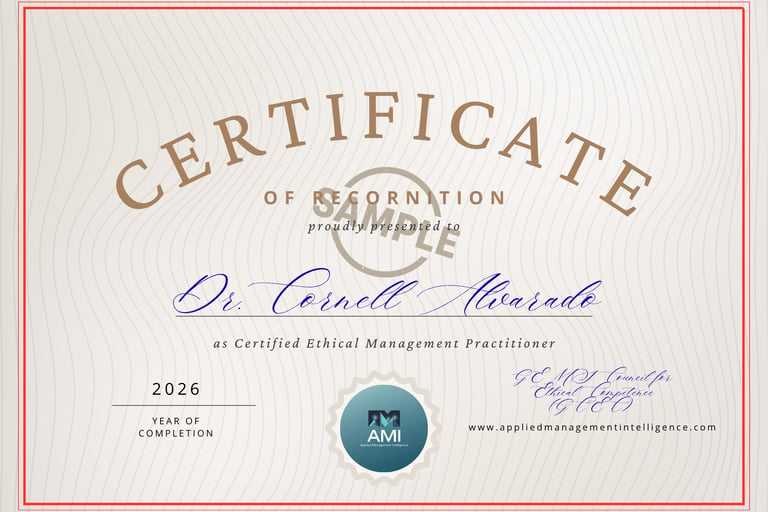
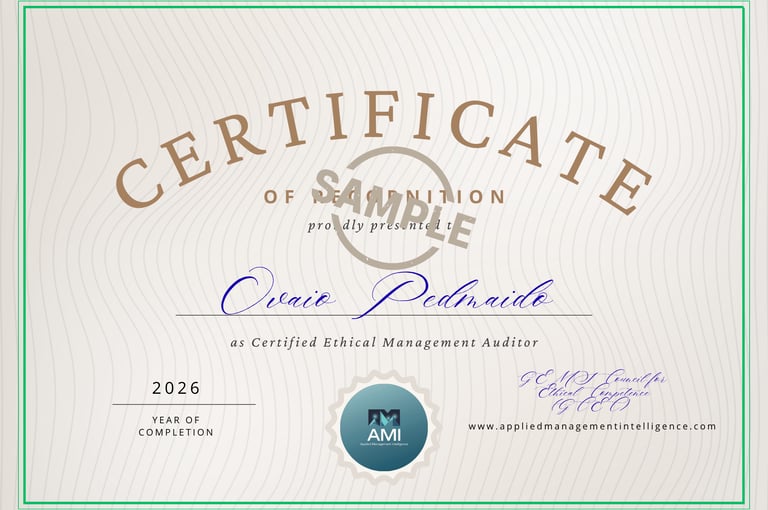
Successful candidates will receive official confirmation of their achievement and the issuance of a GEMS-AMI Certificate, recognizing their verified competence in ethical and data-driven management.
Professional Commitment and Continuing Recognition
Newly Certified Managers formally affirm their adherence to the Global Ethical Management Standards (GEMS) as part of their professional commitment to integrity, transparency, and accountability.
There is no recertification requirement, provided that the Certified Manager:
Remains subscribed to the AMI Professional Newsletter,
Continues to engage in ongoing professional development through reading and applying the materials provided, and
Demonstrates continuous adherence to GEMS principles within their professional practice through annual confirmation that manager was not disqualified as a manager by their employer.
Sustaining Ethical Excellence
The ongoing connection through the AMI Newsletter ensures that Certified Managers stay informed about the latest insights in ethical intelligence, management innovation, and responsible leadership.
This commitment sustains both professional relevance and ethical alignment with the evolving GEMS ecosystem.
Becoming AMI Certified means joining a global community of professionals dedicated to managing with intelligence, ethics, and impact — ensuring that ethics remains a living, measurable standard in every decision.


Advantages of AMI-AML Certification: Building Ethical Intelligence and Managerial Excellence
The AMI-AML Certification Framework transforms ethics from a compliance function into a strategic management capability.
It equips both organizations and professionals to think, decide, and act with integrity, intelligence, and accountability.
Below is a clear outline of its core advantages.
Unified Ethical and Managerial Competence
The AMI-AML Certification ensures that ethical values and management performance are not separate concepts.
It provides a common structure where ethics, intelligence, and literacy are integrated into every aspect of leadership and operations.
Key advantage:
Creates professionals who can manage ethics as efficiently as they manage strategy, performance, and innovation.
Verified Professional Competence as a Manager
Each certification level (CEMP, CEMI, CEMA, CEMAr) provides a verifiable qualification backed by GEMS ensuring that certified professionals demonstrate measurable competence in ethical and managerial literacy.
For individuals:
Credentials in ethical management.
Ability to evaluate management decisions and help organizations to improve their efficiency.
Demonstrated mastery of the five ethical literacies.
For organizations:
Reliable benchmark for hiring, training, and promotion.
Assurance that leadership teams operate with integrity and analytical clarity.
Strategic Advantage Through Ethical Intelligence
Organizations that implement AMI-AML gain a tangible strategic advantage in markets that increasingly value transparency and responsibility.
The framework builds internal systems of ethical intelligence enabling better risk management, stakeholder trust, and innovation oversight.
Benefits include:
More consistent, evidence-based decision-making.
Stronger trust with investors, clients, employees and regulators.
Enhanced brand credibility and corporate reputation.
Alignment with Global Ethical Management Standards (GEMS)
The AMI-AML Certification is directly aligned with the Global Ethical Management Standards (GEMS).
This ensures a seamless connection between individual capability (AML) and managerial intelligence (AMI) on organizational level.
Outcome:
Certified professionals become active drivers of GEMS implementation, accelerating ethical maturity and compliance within their organizations.
Cross-Functional Integration
The AMI-AML model cuts across all organizational functions from strategy and governance to HR, data management, and technology.
Certification holders are trained to integrate ethical logic into multiple systems, improving internal cohesion and accountability.
Advantages:
Unified ethical language across departments.
Improved alignment between leadership, operations, and compliance.
Reduction in ethical conflicts and decision bottlenecks.
Strengthened Decision Quality
Through its focus on Ethical and Analytical Literacy, AMI–AML enhances decision accuracy and transparency.
Managers learn to evaluate the ethical implications of their actions using structured, data-driven reasoning.
Outcome:
Decisions become not only efficient, but defensible and trustworthy.
Measurable Impact and Continuous Improvement
The AMI-AML Certification integrates directly with the Ethical Performance Indicators (EPIs) and Global Ethical Maturity Index (GEMI) under GEMS.
This allows organizations to measure ethical progress and continuously improve over time.
Benefits:
Evidence-based tracking of ethical development.
Demonstrated compliance and maturity for external audits.
Continuous feedback for leadership and governance systems.
Ethical Leadership and Cultural Transformation
Certified professionals act as ethical multipliers — influencing culture, communication, and behavior throughout the organization.
The training builds a mindset of fairness, accountability, and transparency.
Outcome:
An ethical culture that is sustainable, measurable, and embedded into the organization’s DNA.
Future-Ready Technological Competence
The inclusion of Technological Literacy ensures leaders can govern AI, data, and digital systems ethically.
This prepares organizations for the challenges of automation, privacy, and algorithmic decision-making.
Advantage:
Ethical assurance in technology as a critical differentiator in the digital economy.
Scalable Value for Organizations of Any Size
AMI-AML Certification and training are modular and scalable, making them suitable for:
Large enterprises seeking integrated ethical systems.
SMEs aiming for responsible growth and transparency.
Public institutions committed to ethical governance.
Result:
The framework grows with the organization, ensuring that ethics evolves alongside innovation and scale.
Return on Investment (ROI)
The AMI–AML Certification delivers both tangible and intangible returns:
Reduction in ethical and reputational risk.
Improved stakeholder confidence and retention.
Greater operational efficiency through ethical clarity.
Sustainable differentiation in competitive markets.
Ethics, under this model, becomes a value-generating function not a cost.
Global Recognition and Network
Certified professionals join a global network of ethical management experts under the GEMS Council for Ethical Competence (GCEC).
This community promotes collaboration, research, and the exchange of best practices in ethical intelligence and responsible management.
Benefit:
International recognition and access to ongoing professional development and global collaboration.
Level 1. Certified Ethical Management Practitioner


Levels of AMI-AML Certification
Certified Ethical Management Practitioner (CEMP) training contains of 5 domains, starting with Ethical Literacy that equips CEMP candidates with the ability to recognize, evaluate, and address ethical issues embedded in everyday management decisions. It enables managers to act confidently when values conflict with short-term targets or organizational pressure. Ethical Literacy also helps candidates understand how ethical behaviour supports trust, reputation, and long-term performance.
Analytical Literacy, the 2nd part of Certified Ethical Management Practitioner training, develops the competence to use data, metrics, and analysis responsibly and intelligently in management decision-making. Candidates learn how to interpret data critically, recognize limitations, and avoid overreliance on numbers without context.
Operational Literacy, the 3rd part of certification process, prepares CEMP candidates to manage processes, resources, and execution with ethical responsibility and practical discipline. This domain focuses on how everyday operational decisions shape outcomes, risks, and organizational culture. Candidates learn to identify inefficiencies, operational risks, and ethical blind spots embedded in workflows and systems.
Stakeholder Literacy, the 4th part of CEMP training, develops the ability to manage relationships with employees, customers, partners, regulators, and society in a structured and ethical way. Candidates learn that stakeholder trust is not accidental, but the result of deliberate communication, transparency, and fair decision-making. This domain trains managers to identify stakeholder interests, manage conflict, and engage constructively across diverse and sometimes competing expectations.
Technological Literacy, final part of CEMP training, equips candidates to manage digital systems, data, and AI responsibly without needing to be technical specialists. This domain focuses on accountability, oversight, and ethical governance of technology-enabled decisions. Candidates learn how technology can amplify both value and risk, especially when accountability is unclear. The domain provides practical tools to govern AI, protect data integrity, manage technological risk, and support sustainable innovation.
Practical Management: A Comprehensive Guide to Change in the 21st Century is a foundational textbook for management knowledge that was written to answer that gap introducing Applied Management Intelligence (AMI) as a structured framework that redefines management as a measurable, ethical, and accountable profession rather than a personality-driven role.
The textbook addresses the following critical challenges modern organizations can no longer avoid:
The collapse of trust in management, driven by favoritism, bias, and opaque decision-making.
The failure of traditional leadership models to prevent ethical drift and abuse of authority.
The absence of practical accountability systems for managerial decisions.
The rise of AI in management without human ethical control.
The growing mismatch between management education and real workplace demands.
Growing employee disengagement and quiet quitting especially for the gen Z-ers.
Global decline in quality of products and services due to inefficient processes, disengagement and high employee turnover.


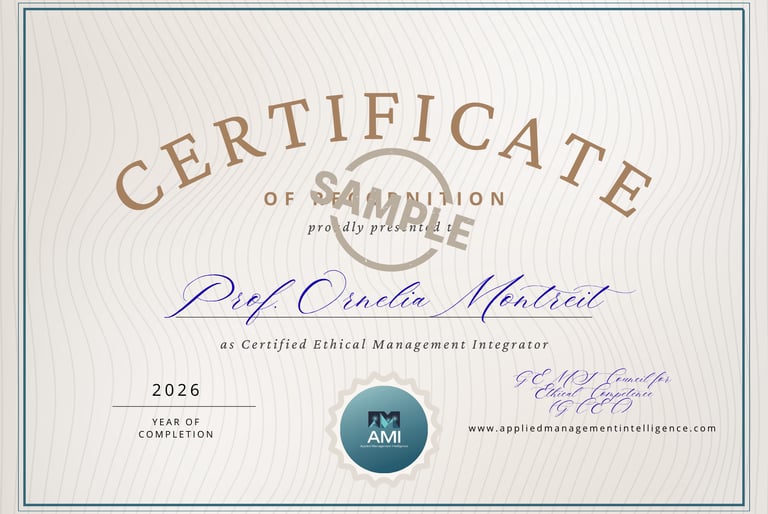
Level 2. Certified Ethical Management Integrator
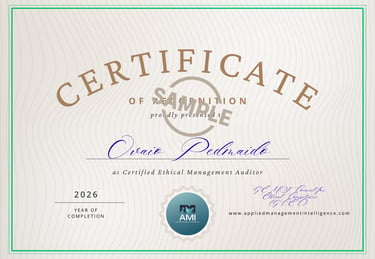
Level 3. Certified Ethical Management Auditor
The Certified Ethical Management Integrator (CEMI) credential is designed for professionals who are responsible for embedding ethical management standards into real organizational systems, processes, and decision frameworks. While CEMP focuses on personal and applied competence, CEMI validates the ability to integrate GEMS across functions, teams, and operational structures.
CEMI holders demonstrate the capability to translate ethical principles and management standards into workflows, governance mechanisms, performance systems, and digital processes. This certification is particularly relevant for managers who act as bridges between strategy and execution, or between leadership intent and operational reality.
The Certified Ethical Management Auditor (CEMA) credential validates advanced competence in assessing, reviewing, and evaluating ethical management practices against GEMS. CEMA holders are qualified to independently examine whether ethical principles, standards, and controls are properly designed, implemented, and functioning as intended.
Unlike CEMP and CEMI, which focus on application and integration, CEMA focuses on verification, assurance, and evidence-based evaluation. Candidates demonstrate the ability to assess management decisions, systems, data practices, AI governance, stakeholder engagement, and operational controls through a structured and objective lens.


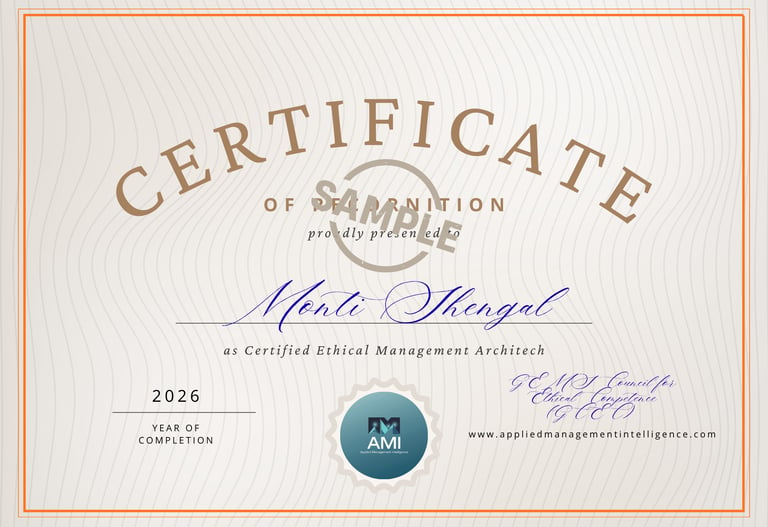
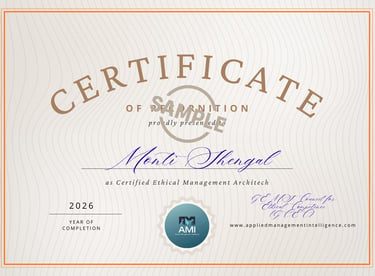
Level 4. Certified Ethical Management Architect
Implementing AMI - GEMS Tools in Organizational Practice: practical, credible, and commercially sound way to implement tools for better decision making
The Certified Ethical Management Architect (CEMAr) is the highest-level credential within the AMI certification framework. It is designed for professionals responsible for designing, evolving, and governing ethical management systems at an organizational or enterprise level relevant for senior leaders, architects of governance frameworks, and those shaping management models in complex or global organizations.
This brochure is designed for organizations and professionals who:
Are facing increasing complexity in decision-making, data use, and AI adoption
Experience recurring issues such as decision reversals, hidden risks, stakeholder disputes, or reputational pressure
Want practical governance, not abstract ethics or compliance checklists
Need to demonstrate ethical management to boards, regulators, partners, or investors
Are preparing for or having just completed AMI-AML certification (CEMP, CEMI, CEMA, CEMAr)
Seek a structured, defensible approach to responsible management in real operating environments
GEMS Council for Ethical Competence (GCEC) reserves the right to offer individuals who earned Certified Ethical Management Architects credentials and remain in good standing to apply for Certification training to become a Certified Ethical Management Trainer which is completed by invitation only. Upon successful completion of this training, Certified Ethical Management Trainer will be able to conduct AML-AML and GEMS training in organizations and educational institutions.




© 2026 Applied Management Intelligence (AMI). All rights reserved.
Content, graphics, and materials are protected under international copyright law.
Reproduction, distribution, or use of this material without written permission from AMI is strictly prohibited.